
Review: Teenage Sex & Death at Camp Miasma
Words: Noah Roper
Imagery: Courtesy of MUBI
In his oft-quoted article, ‘Why We Crave Horror Movies’, literary lord of horror Stephen King suggested that horror movies are ‘innately conservative, even reactionary’: the monstrous other induces viewers to be grateful that they can be protected from its violent existence. Nowhere is this controversial assessment more true than the slasher, with the traditional laws of the genre insisting that promiscuity and hedonism result in the hideous massacres of their typically teenage perpetrators.
By the 00s the power of the slasher was already waning having been satirised beyond satire in the Scary Movie franchise, itself following in the footsteps of Scream which had already worked hard to subvert so many of the tropes of the sub-genre. Now finally, after some time licking its wounds at the bottom of its watery grave, the slasher is reemerging with more than just a contemporary lick of paint, ready to address its confused relationship with conservatism regarding heteronormative sexual relationships and violence from a position of 2020s vigilant self-awareness.

Who better than Jane Schoenbrun – fresh from the success of their sophomore film I Saw the TV Glow – to turn their sights from 90s monster-of-the-week television nostalgia to the camp slasher of the Halloween and Friday the 13th franchises with their exploitative lasciviousness and gratuitous violence that flies in the face of the bizarre politics that King was getting at. Schoenbrun has already shown an acute awareness of the relationship that modern viewers have with media, be it social or cinematic, past or present, and in their latest film it’s the slasher that gets a refreshing look over from a queer filmmaking perspective.
If, in Teenage Sex and Death at Camp Miasma, the title itself highlights the absurdity of the conservatism of slashers with their focus on ‘teenage sex and death’, then the film’s opening scene turns that ridiculousness up to eleven. It starts with a shot from the set of the ‘original’ Camp Miasma series (an in-universe franchise akin to those that were prolific through the 80s) and the filming of on-screen murders turned absurd by the absolute excess of fountains of blood streaming from the victims. From there, an opening credits sequence that mocks the ‘franchisification’ of slashers leaves viewers in no doubt that Schoenbrun is aware of the state of the genre. From the outset it is clear that this will be a film intently aware of the tropes it is dealing with as a ‘meta-slasher’; there will be a great delight taken at poking fun at those tropes and as such this is a much more playful addition to Schoenbrun’s oeuvre than their preceding films.

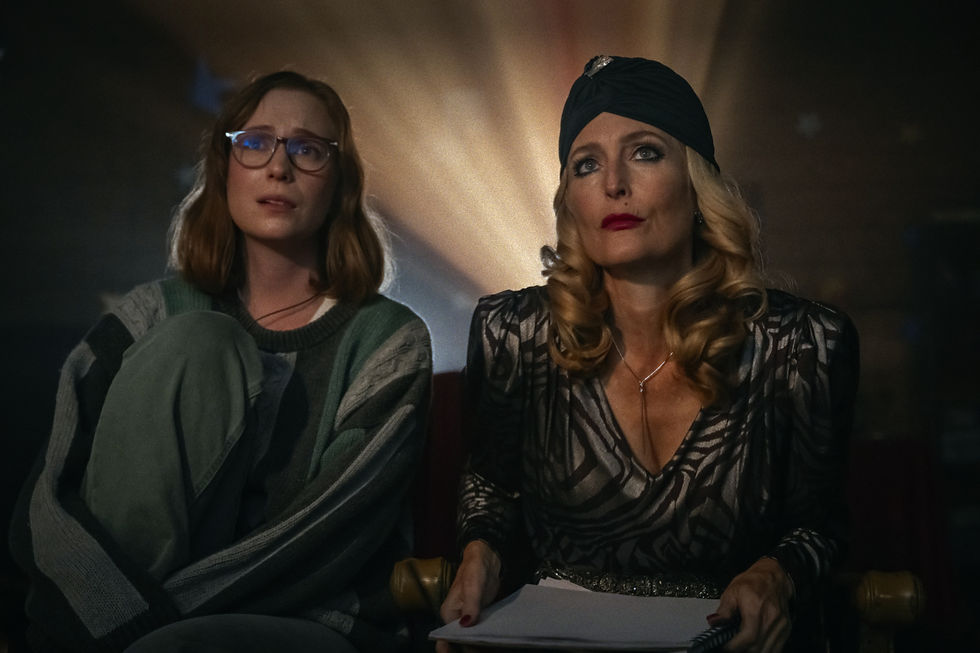
Schoenbrun has made no secret of the fact that they draw upon auto-biographical experiences in their films and, in Camp Miasma, they make even less of an attempt to hide it. The protagonist Kris, played by Hannah Einbinder, a filmmaker attempting to revive the old Miasma franchise, is playfully referred to as a breakout Sundance star, just as Schoenbrun themselves had their own breakthrough with We’re All Going to the World Fair at Sundance. Across from Einbinder is the initially mysterious Gillian Anderson playing Billy Presley, the ‘final girl’ from the first Miasma film who Kris is initially trying to persuade to join their revival project. Kris’ uneasiness at being on the old set of the Miasma films with the ‘reclusive’ older actress does nothing to dampen a growing sexual tension, yet still the lingering uncanniness of a world whose reality isn’t quite as obvious as it might seem begins to muddle the situation with a creeping surrealism that Schoenbrun fans might recognise from the precursor films of the ‘Screen Trilogy’.

The dark moodiness of I Saw the TV Glow is replaced by swirling colours and hyper-modern action sequences though (including an impressive one-shot slasher scene that continues the extreme gratuity of the opening scene). Painted backgrounds and the flickering of film suddenly seep beyond the media depicted in the movie and the distinctions between Anderson’s Billy and the character she once played have seemingly eroded entirely. Questions about how people come to understand the world through their interactions with media are played up beyond the genre of film as an overabundance of colourful consumerism asserts itself on Kris and Billy, including a slow and sensual advert-style sequence in which they enjoy the contents of their KFC more than the average consumer.

These quirks and winks at the audience are impressively parodic but there is a tad too much self-awareness involved that at times hampers the development of deeper themes. The film insists on hammering home how aware it is of the problems that the industry and genre press upon people, sometimes to the detriment of digging beyond a surface level interrogation of these issues. That Einbinder and Anderson are fully committed is therefore crucial, along with Schoenbrun’s continual visual flair and willingness to make strong unconventional decisions with their filmmaking (unashamedly passionate depictions of queer sex are extremely praiseworthy given the continuing sanitisation of Hollywood) even if they don’t quite land with the same weight as in their previous work.
Ultimately, with Teenage Sex and Death at Camp Miasma, Schoenbrun provides a lighter balance to the thematic trilogy it concludes. The film trades the heavier existential questions of I Saw the TV Glow, and We’re All Going to the World’s Fair, for the excitement of a more titillating romp of an experience. Those that enjoy Schoenbrun’s taste for the visually uncanny and themselves have a complicated relationship with the slasher genre, this is for you, but don’t expect a film with the weight of I Saw the TV Glow: for better or worse, Schoenbrun is not trying to recreate that here.


Comments