
Review: Colony
WORDS: Charlie Jones
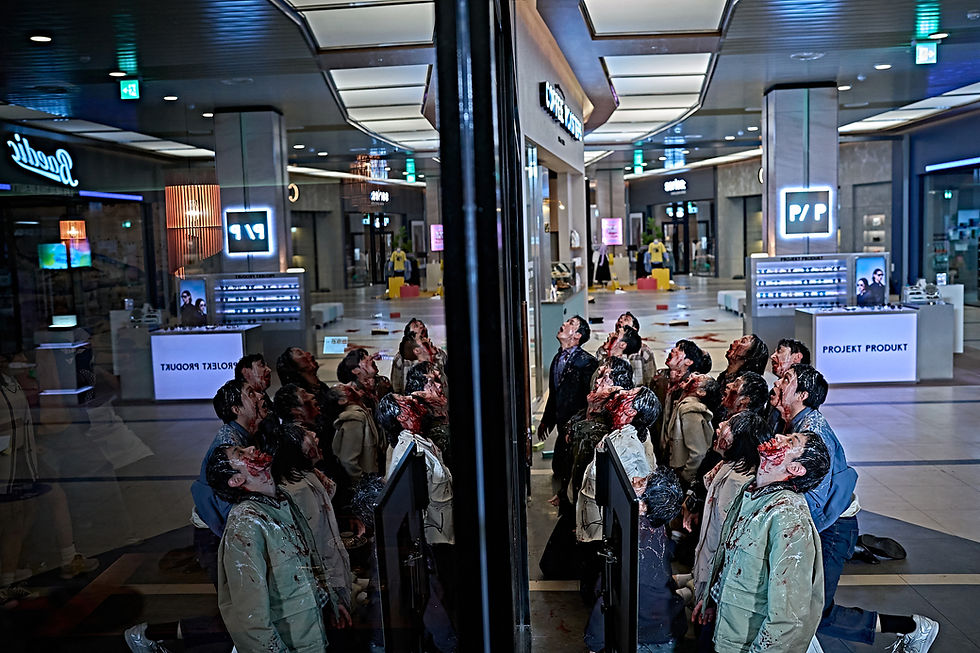
Taking its cues from George Romero’s Dawn of the Dead (1978), Yeon Sang-ho’s Colony, the director’s first zombie film since Peninsula in 2020, sees the survivors of a bio-terrorist attack trapped in a commercial building, fighting for survival against a swarm of flesh-eating zombies. In place of Dawn’s iconic Monroeville Mall is the sky-scraping Dongwoo-ri Building, a shopping mall and conference centre rolled into one, where biotech company CEO Kang Woo-chul (Kim Jong-tae) delivers a presentation on the evolutionary capabilities of slime mould to an enthusiastic audience, including out-of-work biologist Kwon Se-jeong (Jun Ji-hyun) and her sympathetic ex-husband, Han Gyu-sung (Go Soo). Following his presentation, Kang swiftly becomes patient zero in a zombie outbreak.
Like Dawn’s holed-up motley crew, Kwon, Han, and their fellow survivors, including a member of the building’s security team (Ji Chang-wook), his wheelchair-bound sister (Kim Shin-rok), and a trio of quarrelling schoolchildren, must utilise what they have to hand—cardboard signs, advertisement boards, kitchen knives—to fend off the fast-moving, and fast-evolving, zombie horde. The horde’s periodic evolution, from separate individuals crawling on all fours to an upright, interconnected hive mind of bloodthirst, is the brainchild of embittered scientist Seo Young-cheol (Koo Kyo-hwan), who sees his mutating creation as the next step in human evolution, and who has injected himself with the infection’s only vaccine. Of course, the irony is that to defeat this undead hive mind, the survivors must form a hive mind of their own, where each of them is on the same page and working towards a common objective. With their various attitudes and intentions, however, that is easier said than done.

As such, Colony transforms into something altogether different from Dawn of the Dead, or indeed any of its subgenre predecessors. Its central metaphor stretches beyond the mindless consumerism of the 1970s to the mob mentality, tribal (and intra-tribal) divisiveness, and suspicion of science and authority that has so far characterised the 2020s. With such a political core, Colony often evokes the paranoid science-fiction thrillers of the 1970s as much as it evokes zombie films: Escape From the Planet of the Apes (Don Taylor, 1971), Shivers (David Cronenberg, 1975), and especially Philip Kaufman’s Invasion of the Body Snatchers (1978), whose antagonists also exhibit a howling collective consciousness.
As he did with the soppier, shockier Train to Busan (2016), Yeon uses distinct genre archetypes—the scientist, the security guard, the police officer—to define his characters as quickly as possible before the mayhem ensues. His mastery over archetype allows each character to stand out when proceedings become more frenetic and frenzied, their unique individual attributes driving the onslaught of set-pieces that follow the initial zombie outbreak. The trio of quarrelling schoolchildren, whose bullying subplot remains thin, may have benefitted had Yeon fleshed-out their characterisation a touch more, and at the expense perhaps of his fondness for unnecessary flashbacks reminding the audience of key plot points. But even they, underdeveloped as they are, display enough personality to stay in the audience’s mind long after the inevitable casualties begin to stack up.

The poorly-concealed exposition and excessive melodrama evident throughout much of Yeon’s work is easily forgiven here, with his increasingly inventive set-pieces too thrilling, too shocking, and too delightfully revolting to worry about clinging to such minor grievances. Notably, social messaging platforms and other technologies play a significant role in most of these set-pieces. Their prominence highlights the double-edged sword that is contemporary technology and social media, which at times of instability both amplifies panic and misinformation while providing effective lines of communication for resistance movements. Taken together with the spread of the zombie infection, the authorities’ lockdown of the Dongwoo-ri Building, and Seo’s status as ‘the vaccine’, it’s impossible not to see the influence of the year 2020 on Colony, from the COVID pandemic to various global protest movements. Too difficult to ignore, also, are the parallels between the zombies, with their fibreoptic mycelium networks, and real-world artificial intelligence: both are continually learning, continually updating, exponentially growing. How long it is, Colony suggests, before AI devours humanity like a ravenous, omniscient zombie horde depends on how willing we are to fight back against it.



Comments